A Landscape Architecture Blog

Sunday, 17 February 2013

Anti-contextual landscape

The thing that I really like about Tschumi’s Parc de la Villette is a user-defined space that is completely open for interpretation.  A concept that is appropriate to the 'arty' cultural nature of my site in Brighton & Hove...

  
Cinema en Plein Air Festival, at the the PdlV. The Park serves an open-air cultural center, conceptualized as one large user-defined space that is completely open for interpretation.  What new programs are appropriate for my site?

  
Even though most traditional picturesque parks are unprogrammed and usually mean for user definition and interpretation, there is usually still some semblance of desired activity. 


Frederick Law Olmsted, the master of the picturesque, proposed that "in the park the city if not supposed to exist." 20th C urban parks contradict this notion, with the concept of the park, which can no longer be separated from the city

PdlV is a parks designed as much for urban entertainment and social interaction as for individual contact with nature. I like the overall narrative of the PdlV concept. I see my project as more of a infrastructure able to absorb and adept to different programs and functions and to interweave these with city life.

As Smithson pointed about in his musings about Central park....

"A park can no longer be seen as 'a thing-in-itself', but rather as a process of ongoing relationships existing in a physical region - the park becomes a 'thing-for-us.'"

La Villette is anit-contextural, it has no relationship to it's surroundings, history, or landscape precedent... I understand how this works in a land-locked urban plot, but is it possible to follow this mindset for my project, based on it location (i.e. i can't ignore the sea...)!

Saturday, 16 February 2013

Tschumi's Layers

I have been looking at Le Parc De La Villette as a precedent study for my scheme.  The way I have distilled the landscape layers has some similarities with Barnard Tschumi's concept of superimposition of points, lines and surfaces:


The brief called for the imagining and design of an urban park for the 21st Century:


For Tschumi, Parc de la Villette was not meant to be a picturesque park reminiscent of centuries past; it was more of an open expanse that was meant to be explored and discovered by those that visited the site.  A space for activity and interaction that would evoke a sense of freedom within a superimposed organization that would give the visitors points of reference.


Parc de la Villette is designed with three principles of organization which Tschumi classifies as points, lines, and surfaces.  The 135 acre site is organized spatially through a grid of 35 points, or what Tschumi calls follies (as above).  The series of follies give a dimensional and organizational quality to the park serving as points of reference.  The repetitive nature of each folly, even though each one is unique and different, allowing for the visitors to retain a sense of place through the large park.

Tschumi’s lines are essentially the main demarcated movement paths across the park.  Unlike the follies, the paths do not follow any organizational structure; rather they intersect and lead to various points of interest within the park and the surrounding urban area.
Of the 135 acres, 85 acres are dedicated to the green space, which are categorized as surfaces. 


 The 'sequences' within the park that define its prgrammes are like still from a movie - nice drawings too... pre-CAD!

Parc de la Villette focuses on the contrast between defined and undefined circulation. The defined circulation is essentially arbitrary, whilst the paths to the follies are undefined, but are also direct and have purpose. The follies themselves however, are ambiguous in function. In this park, the designed space acts a frame, in which spontaneous events can occur – thus reinventing the architecture every time it is reinterpreted. It is a hybrid of form and experience. I find this concept very interesting and relevant in term of 'organising' the space on my site.

The follies remined me of my art in context work... Richard Serra often describes his sculptural works as 'organising space':  " a structural element that creates a volume of space within the architectural space that is different in kind..." En masse the follies, allow the space to be redefined and reinterpreted.


The orgaisation of space is going  to be fundamental in the development of my masterplan. Dealing with scale , mass and gravity, like Serra - but across my site, like Tschumi.


Tuesday, 12 February 2013

String Models -

Further thoughts on the landscape layers... sky, sea, land.  Separating and representing the elements with string on the scanner, quite a nice quick method:


Distilling the landscape...


The coastal panorama... wave and wind action on the strata of the land (above).


Thinking about the temporal nature of the skyline... also the mass of the sky acting on the land - need to 'slice' through this to break the linear nature of the site. 


Thinking about it, the open vista is almost cinematic. Like movie frames, slowed and forwarded depending on the weather conditions. Organizing and capturing spacial arrangement will be key in defining the new promenade. Bernard Tshumi's Manhattan Transcripts, came to mind: the combined concept of frame, sequence and movement within  a space.  


Applying push pull concept to the montage (above).  Cutting through and rearranging the elements, or manipulation of the natural processes. I think this is going to be a key thought going forward - idea of organising space in order to create all encompassing experience.


Organising space, interventions and arrangements that question perceptions within the space. 

Layers

Continuation of my thoughts about the layered nature of the coastal skyline that dominates my site (or lat least the southerly aspect). I'm interested in the churning of the sky, feeding the waves that hit the land.  The sky is akin to a continuous piece of string, continuously fraying and re-knotting itself, like a net over the land.

 
Saw a load of fishing nets at the harbour made me think the temporal nature of the coastal panorama further.


This photo montage is a visual representation of the coastal sky (fishing nets) and the strata of the ground (the steel cable). The gap is the horizon.
  
Naturally, these landscape layers are horizontal. Interesting things happen where the layer blend, or merge. This changes or perception of the landscape and reorganises the space. For example, on a misty or stormy day the horizon almost disappears as the sky and sea merge. This blending of layers square the panorama, alter our or perception of space. This concepts should be explored.

 
I'm interested in challenging the horizontal layers, vertical - introducing interventions that cut through the panorama and serve to amplify the space. 


Connecting the sky to the land is something I want to do within my project… connecting the people to the ephemeral and amplifying the coastal experience. Countering the horizontal nature of the site with vertical interventions may be a way of organising the space...? As in the push - pull concept...?

Wednesday, 6 February 2013

Heavy Skies: 31_01_13

A stormy walk along the beach the other morning got me thinking about the dynamic, ephemeral nature of the sky and it's layered relationship to the sea and land.


Storm clouds rolling over the seascape.  The physical mass of the clouds, heavy with rain, applying pressure to the land - pending violence.


Did this little sketch to describe the layers, the rolling clouds, feeding the sea, creating waves that buffer the land.  Layers of action as 3 dimensional chaos (sky), horizonal, slicing waves (sea) and linear strata (land)


The storm coming in: skyline shot at 5 min intervals.  Illustrates the ephemeral nature of the landscape. I'm interested in how I might capture, amplify and transpose the fluidity of the seascape into the my major design scheme.  Smithson comes to mind "nature does not proceed in a straight line... it is a sprawing development..."

The coast skyline is forever changing.  Sometimes the sky blends with the horizon. I'm interested in 'connecting' the user of the space to the sky.  The sky is arguably the biggest manipulator of the landscape in terms of physical perception - how can interventions into the landscape manipulate the more ephemeral natural processes such as light, shadow and perception?

Site Survey Crit: 28_01_13

We presented our initial site survey and work done on site appreciation. I presented the Push-Pull concept that was well received. Site appreciation perhaps needs to be be 'more emotional' (James Fox).  Equally, Benz suggested I explored mechanical metaphor to describe the push-pull tidal action.

The idea of integration Shoreham Harbour was positively received, although the suggestion was that the site as whole was quite a large under taking. 


Shoreham Port with Hove Lagoon at the bottom of the picture - linking the two areas is an interesting dilemma.  Tom Turner suggested planning 30 years ahead to allow for redefinition of the industry. I'm sure the planners would like to get their hands on this waterfront location. 


Interestingly, Hove Lagoon used to be a tidal pond... I think the groynes were introduced around 1910 and the Lagoon as it is today was constructed in 1929 as a model yacht club, as illustrated in the first historical map. Today there is sailing and windsurfing on the Lagoon. 


The skate Park was built about 7 years ago with a 12K donation for local resident Fat Boy Slim. Looking at the dilapidated tennis courts and the bowling green that are further east along the site, one of the questions raised during the crit was,  "what is a place of pleasure and recreation now...?"

 
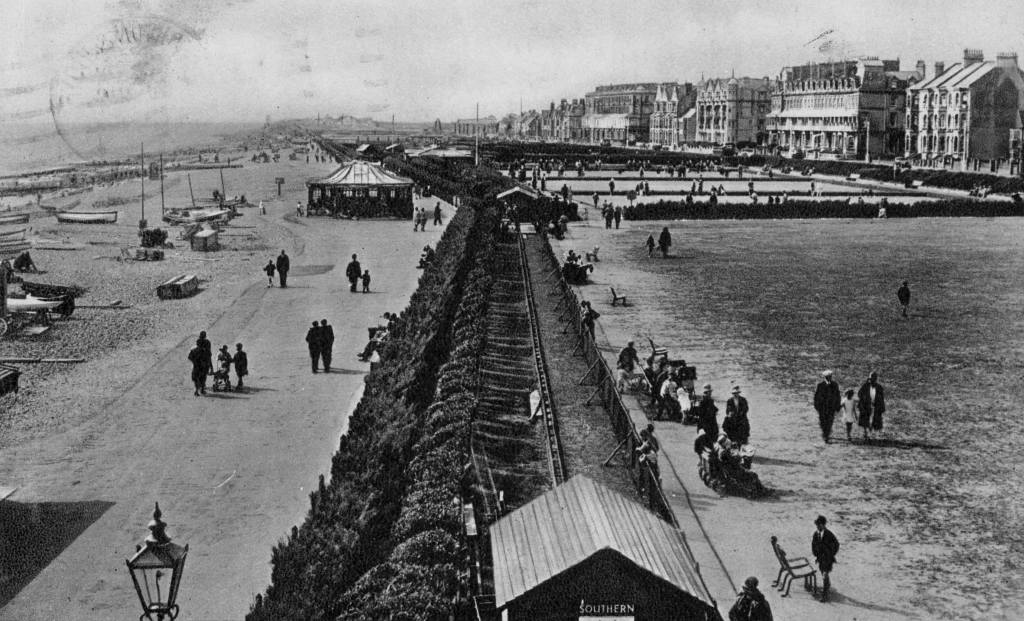
This is a view west from The King Alfred. From July 1928 until the start of the Second World War a miniature steam railway was operated for public rides on Hove Seafront during the summer months. The bowing greens are top right - they remain today... is this what the site needs going forward?!!


Brighton Bootcamp is very popular on the Western Lawns - very Brighton! The site should respond to a changing demographic and the recreational needs of residents and visitors alike.

Tuesday, 5 February 2013

Wave Energy: 'Push - Pull'

A visit to beach made me think about the energy in waves - the push-pull action of wind and gravity, acting as a manipulator of the shoreline...
The push-pull action needs to be amplified to break the linear, horizontal nature of Hove seafront.


Hove Seafront (above) - linear, impenetrable. Land/sea permeability needs to be explored (below).  Green and blue fingers.


Rubber slipway on the beach was interesting, made me think about exposing and revealing layers of the landscape. Perhaps the action of the sea peels back the layer...?


Peeling back the layers, a result of reciprocal push-pull action.


Negative spaces created by action... revealed voids capture material and 'reprogram' the shoreline. 

 'Push - Pull - Capture'